


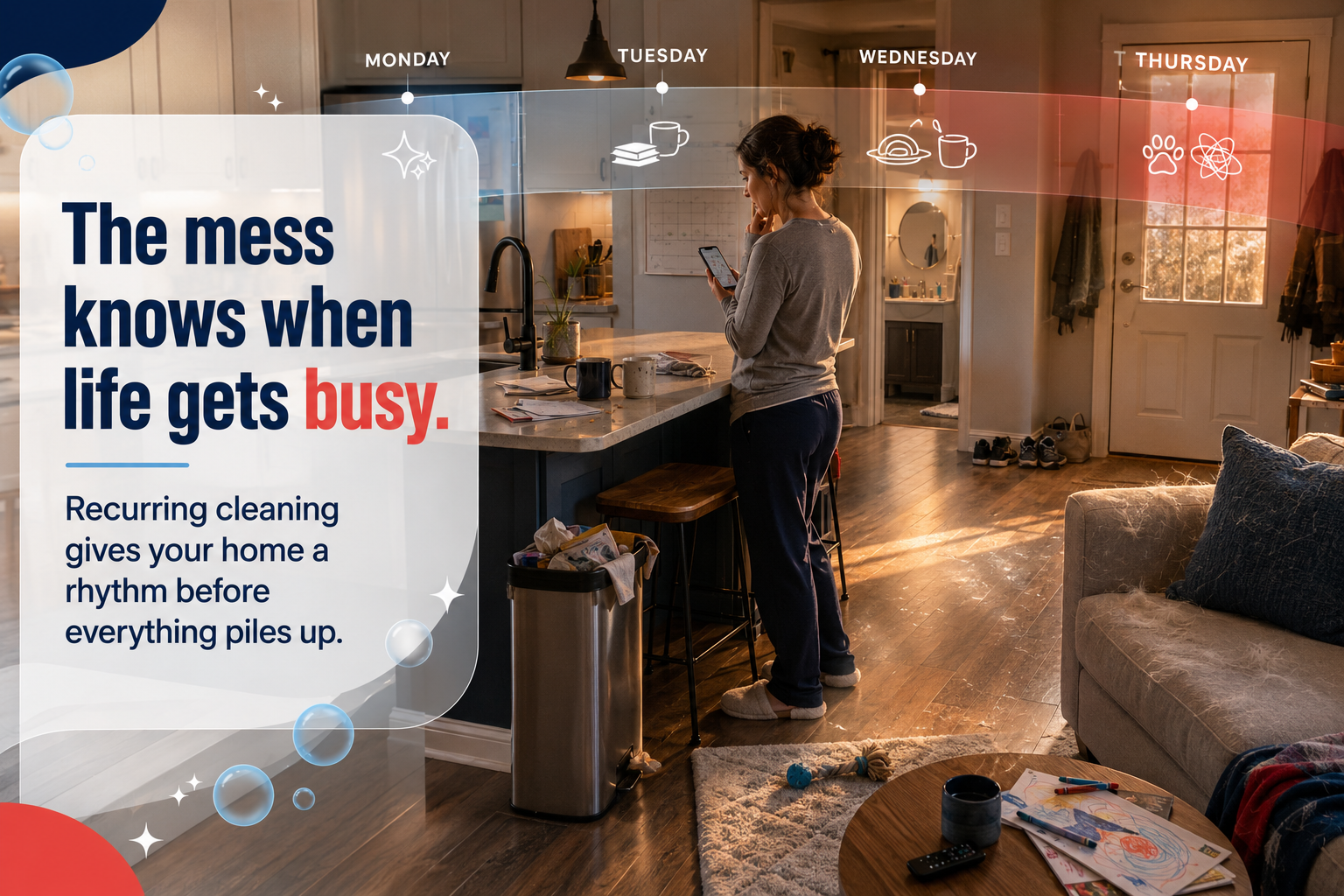
The mess always seems to know when life is busy.
One long workday turns into two. The kitchen counter collects mail, crumbs, and one coffee mug that somehow becomes four. The bathroom mirror gets toothpaste dots. The floors look fine until the afternoon sun hits them and tells the truth.
That is usually when people start asking about recurring house cleaning. Not because they want a perfect-looking home every second, but because they are tired of cleaning only when the house starts winning.
Recurring cleaning gives the home or workplace a steady rhythm. Instead of waiting until everything feels too far gone, cleaning happens on a planned schedule, such as weekly, bi-weekly, monthly, or another routine that fits the way the space is actually used.
Key Takeaways
- Recurring cleaning means scheduled cleaning that happens again and again.
- It is best for homes and businesses that need steady upkeep.
- Weekly, bi-weekly, and monthly cleaning all fit different lifestyles.
- The right plan depends on traffic, pets, kids, work schedules, and how much cleaning happens between visits.
What Is Recurring House Cleaning?
Recurring house cleaning is a regular cleaning service scheduled ahead of time to keep a home consistently clean. Instead of booking a cleaner only when the mess feels overwhelming, visits happen on a set routine.
Most recurring cleaning plans focus on maintenance. That means the cleaner handles the tasks that keep a home fresh from week to week: bathrooms, kitchens, floors, dusting, trash, and commonly used living spaces.
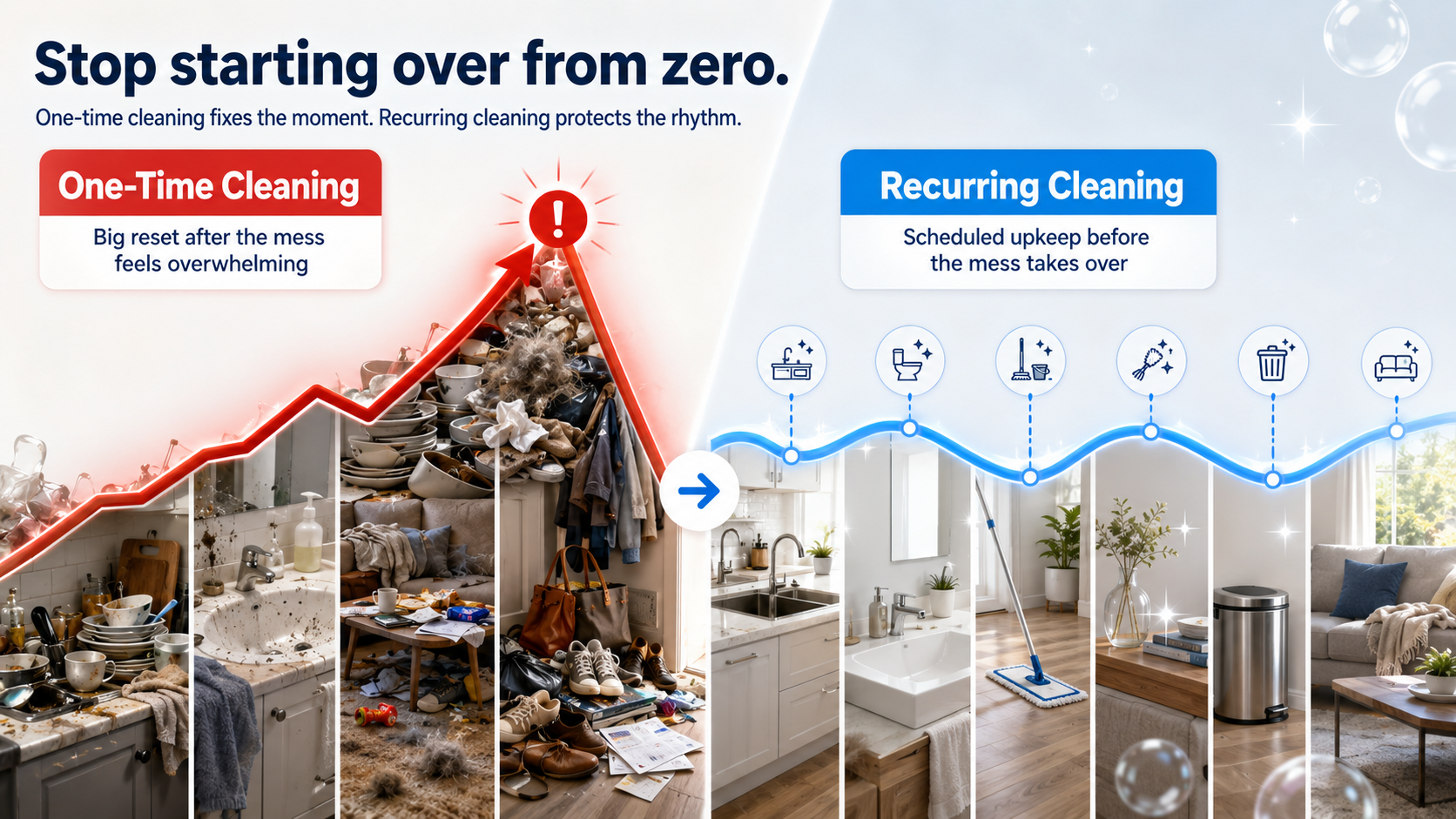
This is different from a one-time clean. A one-time cleaning solves a short-term problem. Recurring cleaning prevents the problem from getting too big in the first place. Some people describe this type of help as maid service, while others call it professional house cleaning or regular home cleaning. The name matters less than the result: reliable upkeep that fits the way the household actually lives.
The same idea applies to small offices and commercial spaces. A business may not need a full reset every week, but it may need clean restrooms, tidy floors, wiped surfaces, and a workplace that feels ready for employees and visitors.
A local recurring cleaning plan can usually be shaped around daily, weekly, bi-weekly, or monthly service for residential and commercial spaces. That flexibility matters because every home has its own rhythm, and every business has its own traffic pattern.
For homeowners comparing home cleaning services, the best choice is usually not the biggest package. It is the plan that keeps the space clean without creating unnecessary cost or service.
Why Do So Many People Fall Behind on Cleaning?
Most people do not fall behind because they are lazy. They fall behind because cleaning is not one job. It is a hundred tiny jobs pretending to be one job.
There are dishes, laundry, floors, counters, bathrooms, pet hair, trash, dust, mail, shoes by the door, and the mystery sticky spot no one wants to claim.
According to the latest available American Time Use Survey from the U.S. Bureau of Labor Statistics, 80 percent of people did household activities on an average day in 2024. That includes work like housework, cooking, lawn care, and household management.
That one number says a lot. Keeping a home running takes regular effort. When work, kids, pets, aging parents, errands, and business needs are added on top, cleaning often drops to the bottom of the list.
Recurring cleaning helps because it removes the repeated question: “When are we going to get to this?”
The answer is already on the calendar.
What Does Recurring Cleaning Include?
Recurring cleaning usually covers the regular tasks that keep a home or workplace comfortable, clean, and easier to manage.
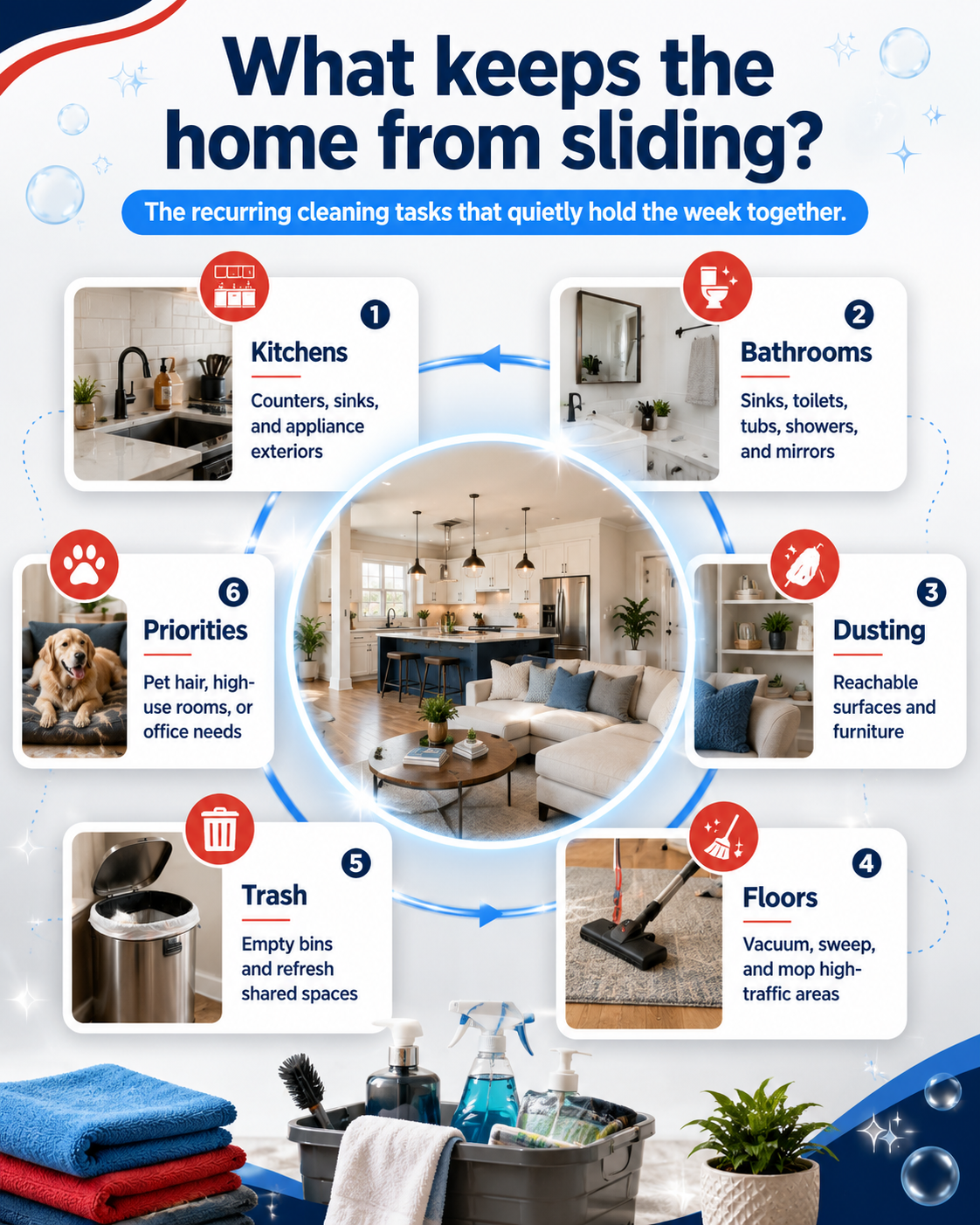
A typical visit may include:
- Cleaning kitchen counters, sinks, and appliance exteriors
- Scrubbing bathroom sinks, toilets, tubs, showers, and mirrors
- Dusting reachable surfaces and furniture
- Vacuuming carpets, rugs, and high-traffic areas
- Sweeping and mopping hard floors
- Emptying trash and refreshing shared spaces
This type of standard cleaning often focuses on visible surfaces, high-use rooms, and routine upkeep. Depending on the home, a visit may also include more detailed kitchen cleaning, extra attention to pet hair, or vacuuming with a vacuum cleaner suited to the flooring.
The exact checklist should depend on the space. A house with pets may need more attention to floors and furniture. A busy family may need extra help in the kitchen and bathrooms. A small office may need restroom cleaning, trash removal, floors, and high-touch surfaces handled on a reliable schedule.
The best recurring cleaning service does not treat every home the same. It looks at how people actually live.
That is where recurring house cleaning services become practical instead of generic. The work should match the home, not a copy-and-paste checklist.
A good cleaning checklist should also leave room for priorities. One home may need more dust removal, while another may need help keeping bathrooms, floors, and shared spaces consistently clean.
How Often Should You Schedule Recurring Cleaning?
The right schedule depends on how quickly the space gets messy and how much you want to handle between visits.
Weekly cleaning works well when the home is busy, the floors get dirty fast, or no one wants to spend weekends catching up. Bi-weekly cleaning is a strong fit for many households because it gives consistent support without feeling excessive. Monthly cleaning can work for lighter-use spaces or people who already keep up with the small daily tasks.
Some customers prefer weekly or bi-weekly service because it keeps the home from sliding too far between visits. Others choose monthly recurring cleaning when they mainly need a reset and light maintenance support.
Here is a simple way to think about it:
| Cleaning Schedule | Best For | A Simple Cue | Common Mistake |
| Weekly house cleaning | Busy families, pet owners, high-traffic homes | The house feels messy again within a few days | Choosing bi-weekly when the home clearly needs weekly help |
| Bi-weekly cleaning | Moderate-use homes with some upkeep between visits | The home stays manageable for about a week | Expecting it to fix heavy daily mess |
| Monthly cleaning service | Smaller homes, tidy renters, low-traffic spaces | The home needs a reset, not constant support | Waiting too long when buildup appears quickly |
| Commercial recurring cleaning | Offices, shops, shared workspaces, rental properties | Customers or employees use the space often | Cleaning only after people notice the mess |
A good rule is simple: if the home feels stressful long before the next visit, the schedule is probably too far apart.
Who Is Recurring Cleaning Best For?
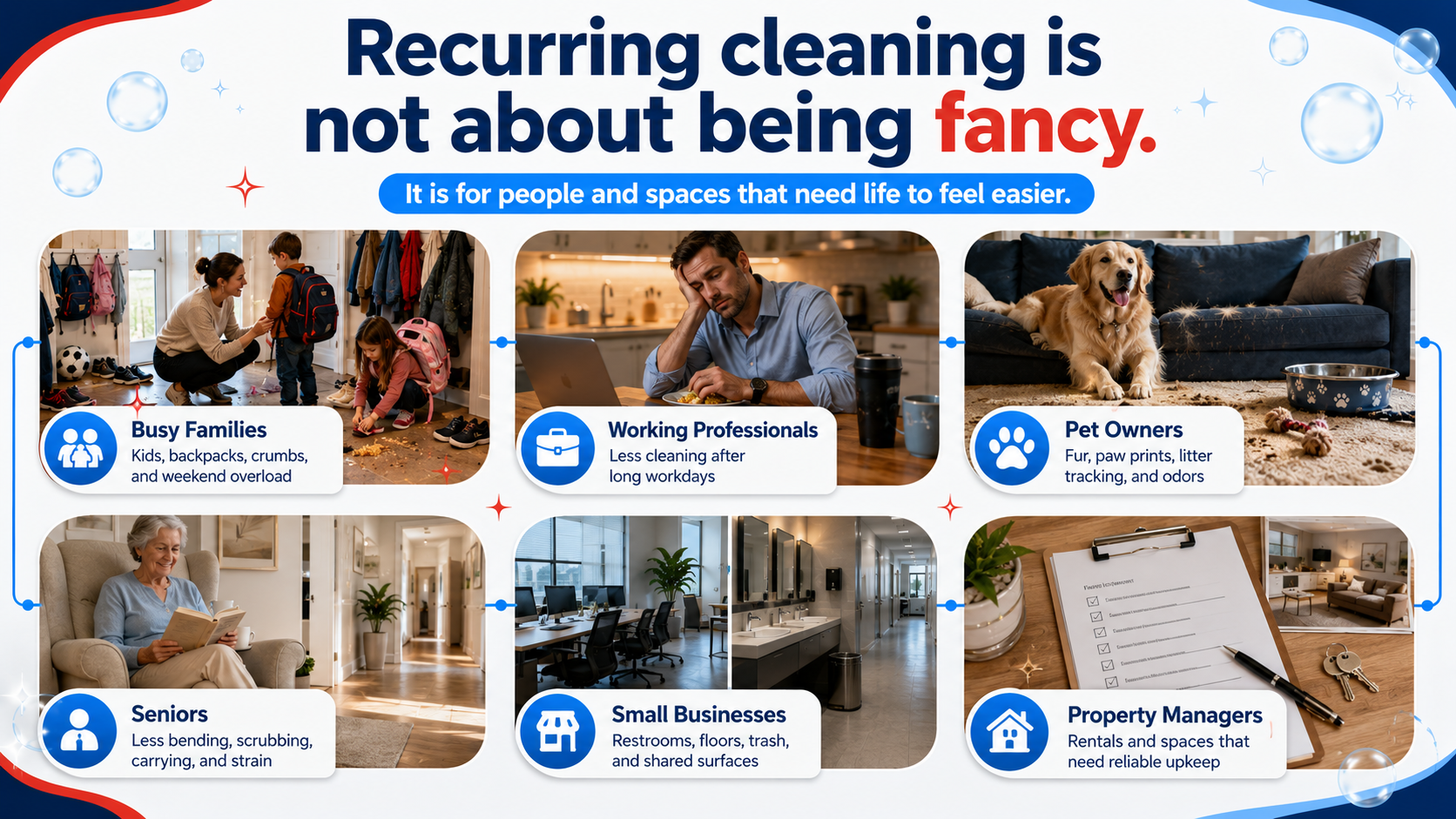
Recurring cleaning is best for people who want a cleaner space without restarting the process from scratch every week or month.
It is especially helpful for busy families. Kids do not mean to turn a living room into a tiny obstacle course, but somehow shoes, toys, snacks, and backpacks all find their way there. Weekly or bi-weekly cleaning helps keep the home from feeling like a full-time project.
The BLS American Time Use Survey also shows how much household work competes with family life: among adults living with children under 18, employed adults spent 1.7 hours per day on household activities, while those not employed spent 3.1 hours per day.
It is also useful for working professionals. After a long day, most people do not want to choose between cleaning the bathroom and sitting down for dinner. Regular home cleaning gives them back time and breathing room.
Pet owners often benefit too. Fur, paw prints, litter tracking, and odors build up quickly. A recurring cleaning service helps keep those small messes from becoming the personality of the house.
Seniors may choose scheduled house cleaning because it reduces physical strain. Bending, scrubbing, carrying supplies, and mopping floors can become harder over time. A reliable cleaning routine helps the home stay safe, fresh, and easier to move through.
Small business owners and property managers also benefit. Clean spaces affect how people feel when they walk in. A tidy office, rental, or storefront sends a quiet message: someone cares about this place.
For local homeowners, residential cleaning services can be especially useful when the goal is not just a cleaner home, but a more manageable weekly routine.
Recurring Cleaning vs. Deep Cleaning: What Is the Difference?
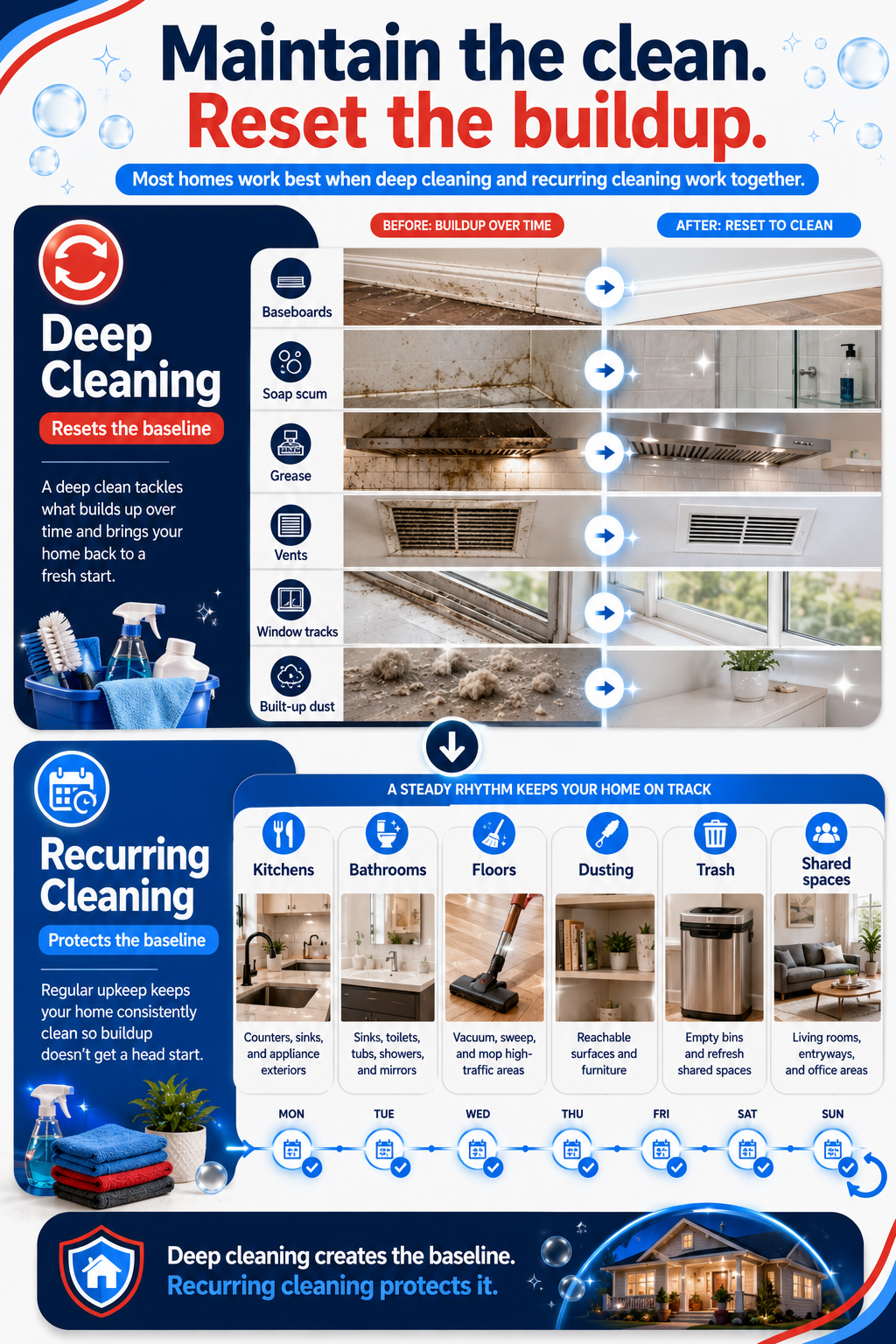
Recurring cleaning maintains a space. Deep cleaning resets it.
That difference matters.
Routine cleaning handles the regular tasks: counters, sinks, bathrooms, mirrors, floors, dusting, trash, and commonly touched areas. Deep cleaning goes further. It may include baseboards, built-up soap scum, heavy kitchen grease, inside appliances, vents, window tracks, and other detailed areas that are not part of every routine visit.
Many homes do best with both. A deep cleaning can bring the space back to a better starting point. Then recurring cleaning keeps it from sliding backward.
| Real-world example: Woman’s Touch Cleaning shared a residential case study where homeowners in a three-bedroom house needed weekly deep cleaning to keep the home ready for visitors. Their team cleaned major areas like the kitchen, bathrooms, living areas, and bedrooms, and the result was a home that stayed consistently clean without the owners spending excessive time on cleaning tasks. Source: Woman’s Touch Cleaning case studies |
A deep cleaning service is often the better first step when the home has heavy buildup, strong odors, or areas that have not been cleaned thoroughly in a while. After that, regular visits help the home stay under control.
Think of it like dental care. Brushing every day matters, but sometimes a deeper professional cleaning is needed. The same idea works in a home. Maintenance is easier when the baseline is already clean.
CDC cleaning guidance also makes a helpful distinction: cleaning, sanitizing, and disinfecting are not the same thing. The CDC explains that cleaning removes most germs, dirt, and impurities from surfaces using water, soap, and scrubbing.
That matters because a good cleaning plan should use the right method for the right situation, especially around high-touch surfaces.
The 3-Part “Right Fit” Test
Choosing a cleaning schedule gets easier when you look at three things: traffic, tolerance, and time.
1. TRAFFIC
How many people use the space every day? A home with children, pets, guests, or remote workers usually needs more frequent cleaning than a quiet apartment.
2. TOLERANCE
Some people feel fine with a little clutter. Others cannot relax if the counters are sticky or the bathroom sink has spots. There is no universal answer. The right cleaning plan should fit the comfort level of the people using the space.
3. TIME
Be honest about what will actually get done between visits. If everyone is already stretched thin, weekly cleaning may make more sense. If the household can handle dishes, laundry, and quick wipe-downs, bi-weekly cleaning may be enough.
This three-part test helps prevent the most common mistake: choosing the cheapest or least frequent option, then feeling frustrated because it does not match the real mess.

Signs Your Cleaning Plan Needs a Small Adjustment
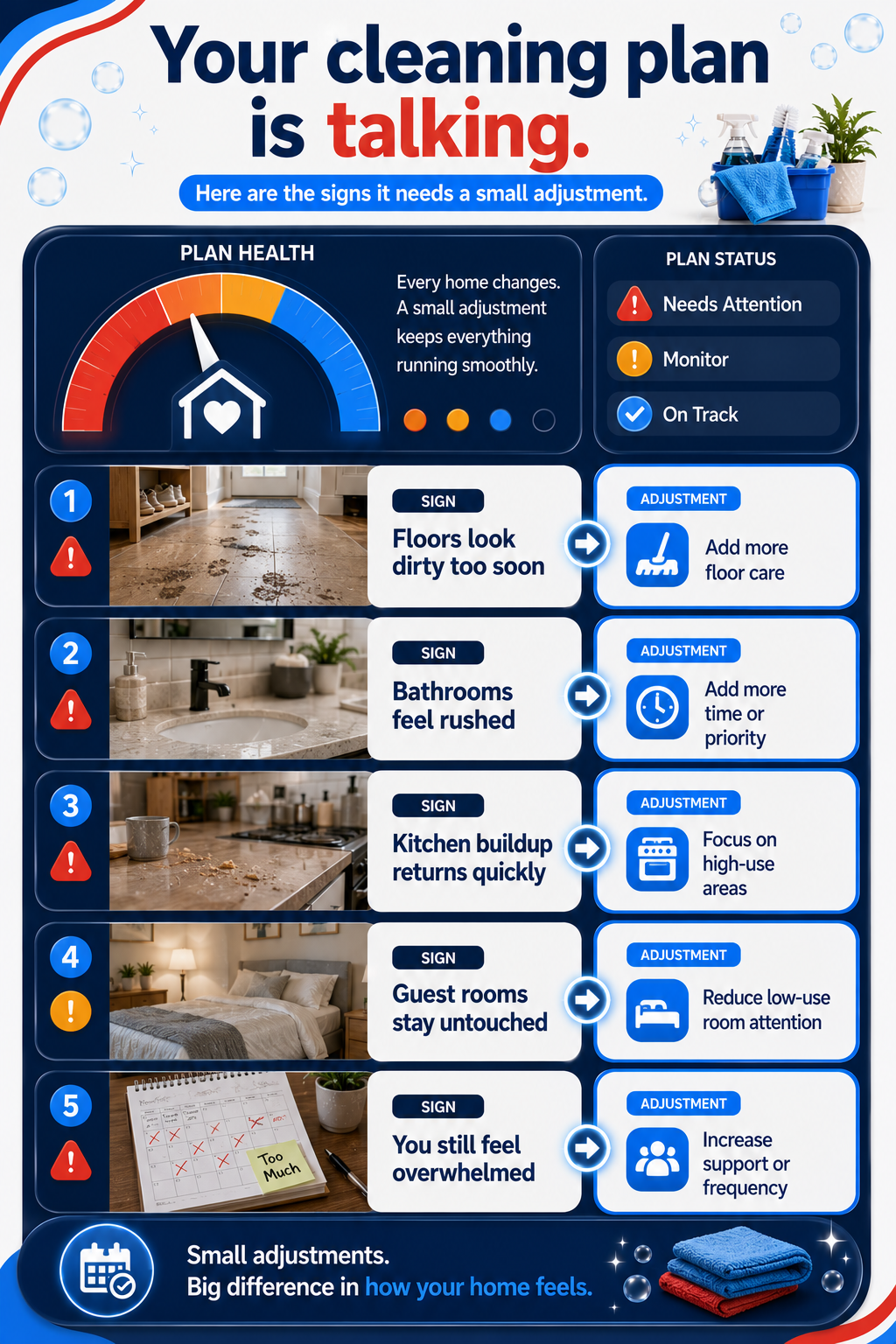
A recurring cleaning plan does not have to stay the same forever. If the home’s needs change, the schedule or priorities can usually change too.
| Sign | What It May Mean |
| Floors look dirty too soon | More floor care may be needed |
| Bathrooms feel rushed | Add more time or priority |
| Kitchen buildup returns quickly | Focus more on high-use areas |
| Guest rooms stay untouched | Reduce low-use room attention |
| You still feel overwhelmed | Increase support or frequency |
What Most People Get Wrong About Recurring Cleaning
The biggest misunderstanding is thinking recurring cleaning is only for homes that are already messy.
It is often the opposite.
Recurring cleaning works best for people who want to avoid the big mess in the first place. It is not about being fancy. It is about staying ahead.
Another mistake is expecting cleaners to work around clutter. Professional cleaners can clean surfaces, floors, bathrooms, kitchens, and rooms more efficiently when personal items are picked up first. That does not mean the house has to be spotless before a visit. It just means the cleaner can spend more time cleaning and less time moving things.
A third mistake is treating every room equally. The kitchen used three times a day needs more attention than the guest room no one has entered since Thanksgiving. A customized cleaning schedule should follow the way the home is used. That is why customized cleaning matters. A practical routine should focus on the rooms, surfaces, and problem areas that affect daily life the most.
William Morris said, “Have nothing in your houses that you do not know to be useful, or believe to be beautiful.”
That line is old, but the idea still fits. A home does not have to be perfect. It should feel useful, comfortable, and cared for.
Do This, Not That
Use this simple guide when deciding how to manage routine cleaning:
- Do choose weekly cleaning if mess returns quickly.
- Do choose bi-weekly cleaning if the home stays fairly manageable between visits.
- Do choose monthly cleaning if the space has light use.
- Do start with a deep clean if the home has heavy buildup.
- Do share priorities before service begins.
And try to avoid these habits:
- Do not wait until the home feels overwhelming every time.
- Do not assume monthly cleaning can do the job of weekly cleaning.
- Do not use the same checklist for every room.
- Do not ignore pets, traffic, allergies, or surface care needs.
- Do not choose a cleaning plan without thinking about real life.
For households that care about product safety, the EPA Safer Choice program can also be a helpful reference. It helps consumers and businesses find products that perform and contain ingredients safer for human health and the environment.
Customers can also ask about green cleaning, eco-friendly cleaning, and eco-friendly cleaning products if fragrance, allergies, pets, or children are part of the decision. The right cleaning products, cleaning supplies, and cleaning agent should support the home’s needs without creating avoidable concerns.
Cleaning Preferences to Share With Your Cleaner
Sharing preferences before service begins helps the cleaner protect surfaces, avoid product issues, and focus on what matters most in the home.
| Preference | Example |
| Fragrance level | Unscented or light scent |
| Product type | Eco-friendly or standard |
| Pet concerns | Avoid sprays near pet areas |
| Surface care | Special care for wood or stone |
| Allergy needs | Low-fragrance, dust-focused cleaning |
A Familiar Local Scenario
Picture a home in Joliet on a Thursday night.
The week started strong. The counters were clear on Monday. The floors looked fine on Tuesday. By Thursday, the entryway has shoes, the kitchen has crumbs, the bathroom needs attention, and the dog has gifted the sofa a new layer of fur.
No one failed. Life just happened.
Now picture the same home with a bi-weekly or weekly cleaning plan. The family still handles daily basics like dishes, laundry, and picking up clutter. But the heavier routine cleaning no longer waits until Saturday morning. Bathrooms, floors, dust, and kitchen surfaces stay on a steady cycle.
The same thing happens in a small office. Employees may keep their desks tidy, but shared spaces need a real plan. Restrooms, floors, trash, and surfaces should not depend on whoever notices first.
That is the quiet value of recurring cleaning. It gives the space a rhythm people can count on.
How to Prepare for a Recurring Cleaning Visit
A little preparation helps the cleaning visit go smoothly.
Before the cleaner arrives:
- Pick up loose items like clothes, toys, papers, and dishes.
- Share priority areas, such as bathrooms, floors, pet zones, or the kitchen.
- Mention delicate surfaces, allergies, fragrance preferences, or product concerns.
- Secure pets if they are nervous, excited, or likely to follow the cleaner around.
- Review the plan after the first visit and adjust what needs attention.
The goal is not to clean before the cleaner. That would be like eating before dinner reservations because you do not want to trouble the chef.
The goal is to make the space ready enough that the cleaning time goes where it matters.
When Is Recurring Cleaning Not the Best First Step?
Recurring cleaning may not be the best first step if the home needs a serious reset.
If there is heavy buildup, thick dust, old grease, strong odors, or bathrooms that need detailed scrubbing, deep cleaning should usually come first. Once the space is back to a manageable baseline, recurring cleaning can maintain it.
It may also be more service than needed for a rarely used home, a very tidy apartment, or a small space with light traffic. In that case, monthly service or occasional cleaning may be enough.
The best plan is not the biggest plan. It is the one that fits.
Final Thoughts
Recurring house cleaning is not about chasing a spotless home every minute. It is about making the space easier to live in, work in, and enjoy.
For busy families, renters, homeowners, seniors, pet owners, property managers, and small business owners, the right cleaning schedule can remove a surprising amount of stress. Weekly, bi-weekly, or monthly, the point is the same: less catching up, more staying ahead. The best house cleaning plan is the one that feels realistic, consistent, and useful. With a trusted cleaning team and a schedule that fits real life, recurring cleaning can help maintain a clean, comfortable, and more sparkling clean home without turning weekends into catch-up days.

To schedule service with Lajas Cleaning Services, call 1 (815) 325-2365 or email [email protected].
FAQ
What is recurring house cleaning?
Recurring house cleaning is a regular cleaning service scheduled ahead of time to maintain a clean home week after week or month after month.
What does recurring cleaning include?
It usually includes kitchens, bathrooms, dusting, vacuuming, mopping, trash removal, and other routine cleaning tasks.
How often should I schedule house cleaning?
Weekly works best for busy homes, bi-weekly fits many average households, and monthly can work for lighter-use spaces.
Weekly vs biweekly cleaning: which is better?
Weekly cleaning is better for homes with kids, pets, or heavy traffic. Bi-weekly cleaning works well when the home gets light upkeep between visits.
Recurring cleaning vs deep cleaning: what is the difference?
Recurring cleaning maintains the home. Deep cleaning handles heavier buildup, detailed areas, and tasks that are not usually done every visit.
How can someone book recurring house cleaning?
Most customers can book recurring house cleaning by calling, requesting a quote, or using an online booking form if the company offers one.
What should someone look for in a professional recurring cleaning company?
Look for clear communication, reliable scheduling, trained professional cleaners, insurance, strong reviews, and flexible service options.
Is affordable recurring cleaning worth it?
Yes, if it saves time, prevents buildup, and helps the home stay easier to manage between visits.
Why choose a bonded and insured cleaning company?
A bonded and insured cleaning company gives customers more confidence that the provider takes professionalism and accountability seriously.
Does this cleaning company offer recurring cleaning in Joliet?
Yes, recurring cleaning is available for residential and commercial spaces in Joliet and nearby Illinois service areas.