


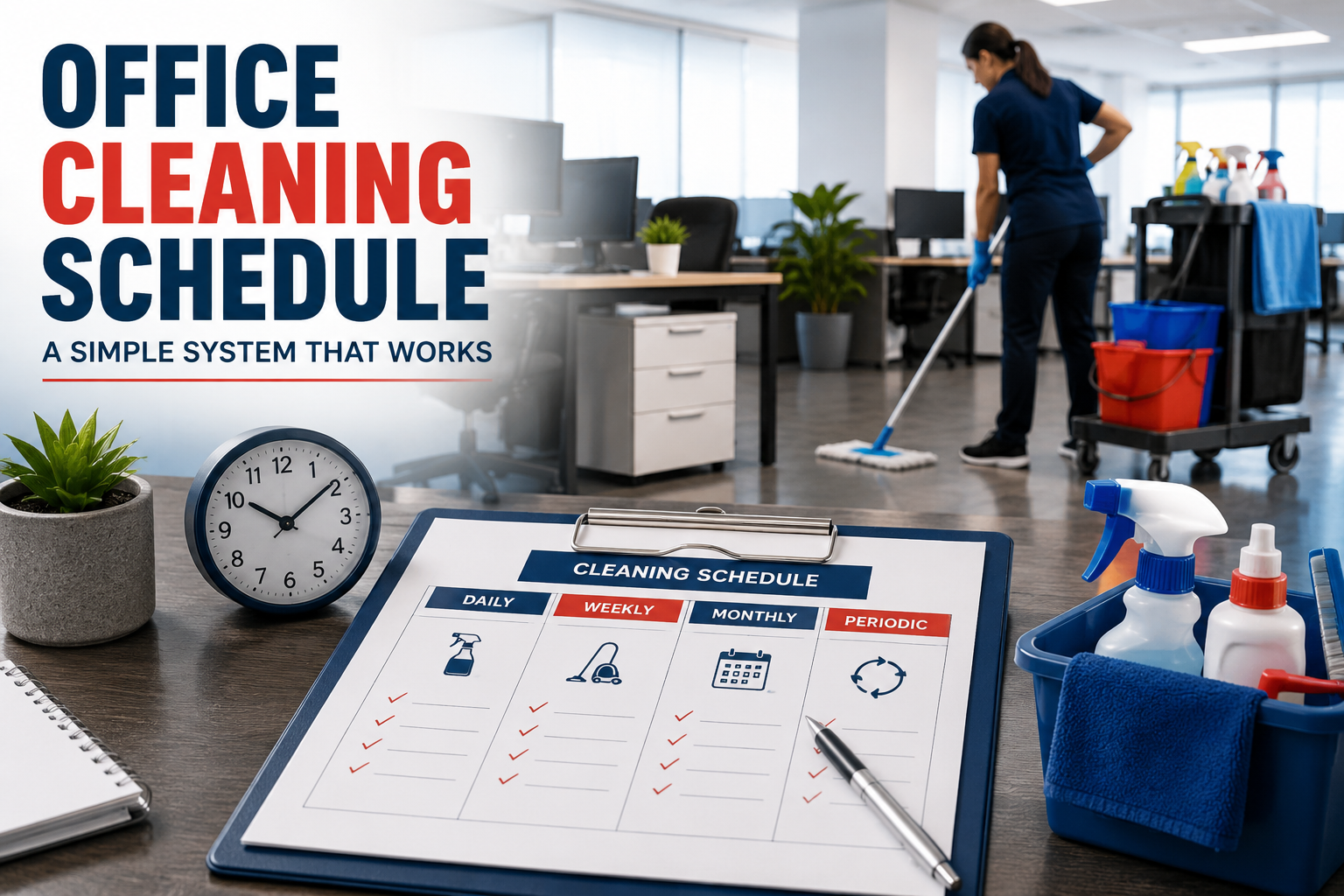
A clean office does not happen because someone remembers to wipe a desk every now and then.
It happens because there is a system.
Without a clear office cleaning schedule, some areas get cleaned constantly while others are forgotten. Trash may be taken out every day, but baseboards collect dust for months. The kitchen gets attention after lunch, while glass doors, conference rooms, and less-used spaces slowly build up grime.
The problem is rarely that a business does not care about cleanliness.
The problem is that cleaning responsibilities are often handled reactively.
A better approach is to create a schedule that tells you what needs to be cleaned, how often it needs attention, who is responsible, and when professional cleaning should be brought in.
The right schedule does not need to be complicated. It just needs to match the way your business actually operates.
Key Takeaways
- An effective workplace cleaning schedule separates daily, weekly, monthly, and periodic tasks.
- High-traffic areas usually need more frequent attention than low-use spaces.
- Small offices, retail businesses, restaurants, and professional buildings may require different cleaning routines.
- Assigning responsibilities clearly helps prevent missed tasks and inconsistent maintenance.
- A professional commercial cleaning service can handle larger recurring tasks while employees focus on everyday upkeep.
Why Every Business Needs an Office Cleaning Schedule
Imagine an office where everyone assumes someone else cleaned the kitchen.
At the end of the day, the trash is still full. The counters are covered with crumbs. The sink needs attention. Nobody knows whether the floors were vacuumed.
Now imagine a second office where cleaning responsibilities are clearly organized.
Employees know what they are expected to handle. The cleaning provider knows what needs to be completed. The manager knows when recurring service is scheduled.
The difference is not necessarily the amount of work.
It is the system.
A structured office cleaning routine makes cleaning predictable and helps prevent important tasks from being forgotten.
It also makes it easier to notice when the current schedule is no longer keeping up with the business.
Start by Dividing Cleaning Into Four Frequencies
The easiest way to build a workplace cleaning schedule is to divide tasks by how often they need to be completed.
Think of your schedule as four layers:
Daily → Weekly → Monthly → Periodic
Daily tasks keep high-use areas under control.
Weekly tasks handle deeper routine maintenance.
Monthly tasks target areas that need less frequent attention.
Periodic tasks address seasonal, specialized, or occasional cleaning needs.
This structure works for both small offices and larger commercial spaces.
Daily Office Cleaning Tasks
Daily cleaning should focus on areas that experience frequent use.
These are the spaces where dirt, food particles, fingerprints, and trash can accumulate quickly.
Typical daily tasks may include:
- Emptying trash
- Cleaning common kitchen surfaces
- Wiping high-touch surfaces
- Cleaning visible spills
- Maintaining restrooms
- Sweeping or spot-cleaning high-traffic floors
- Tidying shared areas
- Cleaning frequently used entry points
Not every task necessarily needs to be completed by a professional cleaner every day.
Depending on the business, employees may handle light upkeep while professional cleaners manage the more detailed work.
The important thing is that daily responsibilities are clearly defined.
Weekly Office Cleaning Tasks
Weekly tasks can address areas that do not require daily attention but still need regular maintenance.
A weekly office cleaning schedule may include:
- Thorough vacuuming
- Mopping hard floors
- Dusting furniture and surfaces
- Cleaning conference rooms
- Cleaning less frequently used areas
- Detailed restroom cleaning
- Cleaning interior glass
- Dusting accessible fixtures
Weekly service can be particularly useful for offices with moderate traffic.
It keeps the business from relying on one major cleaning session every few weeks.
Monthly Office Cleaning Tasks
Monthly tasks are often where neglected areas begin to show up.
These may include:
- Detailed dusting
- Cleaning vents and other accessible fixtures
- Cleaning under or around furniture
- More detailed kitchen cleaning
- Cleaning doors and frames
- Cleaning areas that receive limited daily attention
A monthly review can also be useful for identifying tasks that need professional attention.
For example, if windows, floors, or high-use surfaces are becoming difficult to maintain, the business may need to increase its cleaning frequency.
Periodic Cleaning Tasks
Some tasks do not belong on a daily or weekly routine.
They may need to happen seasonally, after a major event, or whenever the condition of the property requires them.
Examples include:
- Deep cleaning
- Carpet cleaning
- Post-construction cleaning
- High-level dusting
- Detailed interior glass cleaning
- Special event cleanup
- Seasonal cleaning
These tasks can be added to the calendar ahead of time rather than waiting until the problem becomes obvious.
Build the Schedule Around Your Business Type
A business cleaning schedule should reflect the way the building is used.
An office with ten employees has different needs from a restaurant serving customers throughout the day.
Small Office
A small professional office may need daily trash and restroom attention, weekly floor care, and periodic detailed cleaning.
Retail Business
Retail spaces often need more frequent attention around entrances, floors, customer areas, and high-touch surfaces.
Restaurant
Restaurants typically require more frequent cleaning because food preparation, dining, spills, grease, and customer traffic create a higher daily cleaning demand.
Professional Building
Law offices, medical offices, financial offices, and similar professional spaces may require consistent cleaning in reception areas, conference rooms, restrooms, and shared spaces.
Lajas Cleaning Services provides commercial cleaning for offices, small businesses, retail spaces, restaurants, and professional buildings, making it possible to structure service around different commercial environments.
Use Traffic to Decide Cleaning Frequency
One of the simplest ways to improve your schedule is to stop treating every room equally.
Ask how much traffic each area actually receives.
A main entrance may need daily attention.
A conference room might need weekly cleaning.
A storage room could require much less frequent service.
This approach creates a more realistic office cleaning frequency because cleaning time is focused where it has the greatest impact.
Consider creating three categories:
High-Traffic Areas
Examples include:
- Entrances
- Reception areas
- Break rooms
- Restrooms
- Main hallways
These areas generally need the most frequent attention.
Medium-Traffic Areas
Examples include:
- Conference rooms
- Shared offices
- Meeting spaces
- Common work areas
These can often follow a weekly or routine maintenance schedule.
Low-Traffic Areas
Examples include:
- Storage spaces
- Seasonal-use rooms
- Low-use offices
These may require less frequent cleaning, depending on their condition.
This simple classification can make a cleaning plan more efficient.
Create a Cleaning Responsibility Chart
A schedule works best when everyone knows what they are responsible for.
For example:
| Frequency | Typical Tasks | Responsibility |
| Daily | Trash, visible spills, kitchen upkeep, high-touch areas | Staff + cleaning provider |
| Weekly | Floors, dusting, conference rooms, detailed restrooms | Cleaning provider |
| Monthly | Detailed surfaces, fixtures, less-used areas | Cleaning provider |
| Periodic | Deep cleaning, special projects, seasonal needs | Professional cleaning provider |
The exact division depends on your business.
The purpose is to eliminate uncertainty.
Instead of asking, “Who was supposed to clean that?” the team can look at the schedule and know.
Do Not Make Employees Responsible for Everything
It is reasonable for employees to clean up after themselves.
It is much less realistic to expect employees to handle every aspect of commercial cleaning.
There is a difference between:
Personal upkeep
and
Professional maintenance
An employee can wipe their desk and clean up a spill.
That does not mean they should be responsible for maintaining every restroom, vacuuming the entire office, cleaning large areas of glass, or managing a full commercial cleaning program.
Trying to make employees responsible for too much cleaning can create inconsistent results and take time away from their actual jobs.
A strong commercial cleaning routine gives employees reasonable expectations while assigning larger maintenance tasks to the appropriate cleaning team.
Create a Schedule That Fits Business Hours
Timing matters almost as much as frequency.
A cleaning schedule that interferes with customers, employees, meetings, or production can become difficult to maintain.
For many businesses, professional cleaning can be scheduled:
- Before opening
- After closing
- During low-traffic periods
- During designated maintenance windows
The best time depends on the type of business.
A retail store may need cleaning before opening or after closing.
An office may prefer evening service.
A restaurant may have different cleaning windows based on meal periods.
A schedule should work with the business instead of creating another operational problem.
Include High-Touch Areas in the Routine
A workplace cleaning schedule should clearly identify areas that receive frequent contact.
Examples include:
- Door handles
- Light switches
- Shared equipment
- Kitchen handles
- Elevator buttons
- Common-area surfaces
- Reception counters
These areas can become dirty quickly because so many people interact with them.
Including them directly in the schedule is better than assuming someone will remember them.
Review Floors and Entryways Separately
Floors can make a business look dirty even when other areas are well maintained.
Entryways are particularly important because they receive dirt from outside and experience constant traffic.
Your schedule should therefore identify:
Entrance → Main walkways → Common areas → Individual rooms
High-traffic floors may need daily or frequent attention.
Lower-use floors may need less frequent service.
Again, the goal is not to clean everything equally.
It is to clean everything appropriately.
What Most Businesses Get Wrong About Office Cleaning Schedules
One of the most common mistakes is creating a schedule that looks impressive on paper but is impossible to maintain.
A business may list dozens of daily tasks without considering how long they take or who will actually complete them.
Another mistake is having a schedule without reviewing it.
Businesses change.
Employee numbers increase. Offices move. New equipment is added. Customer traffic changes. A company may even add a kitchen or additional workspace.
The cleaning plan needs to change too.
A third mistake is using the same schedule for every commercial property.
A small office and a restaurant should not automatically have identical cleaning routines.
Do This, Not That
Do this: Build the schedule around traffic and business operations.
Not that: Assign every room the same cleaning frequency.
Do this: Clearly identify who handles each task.
Not that: Assume someone will take care of it.
Do this: Review the schedule when the business changes.
Not that: Keep using an outdated routine because it worked last year.
A Simple Office Cleaning Schedule You Can Actually Use
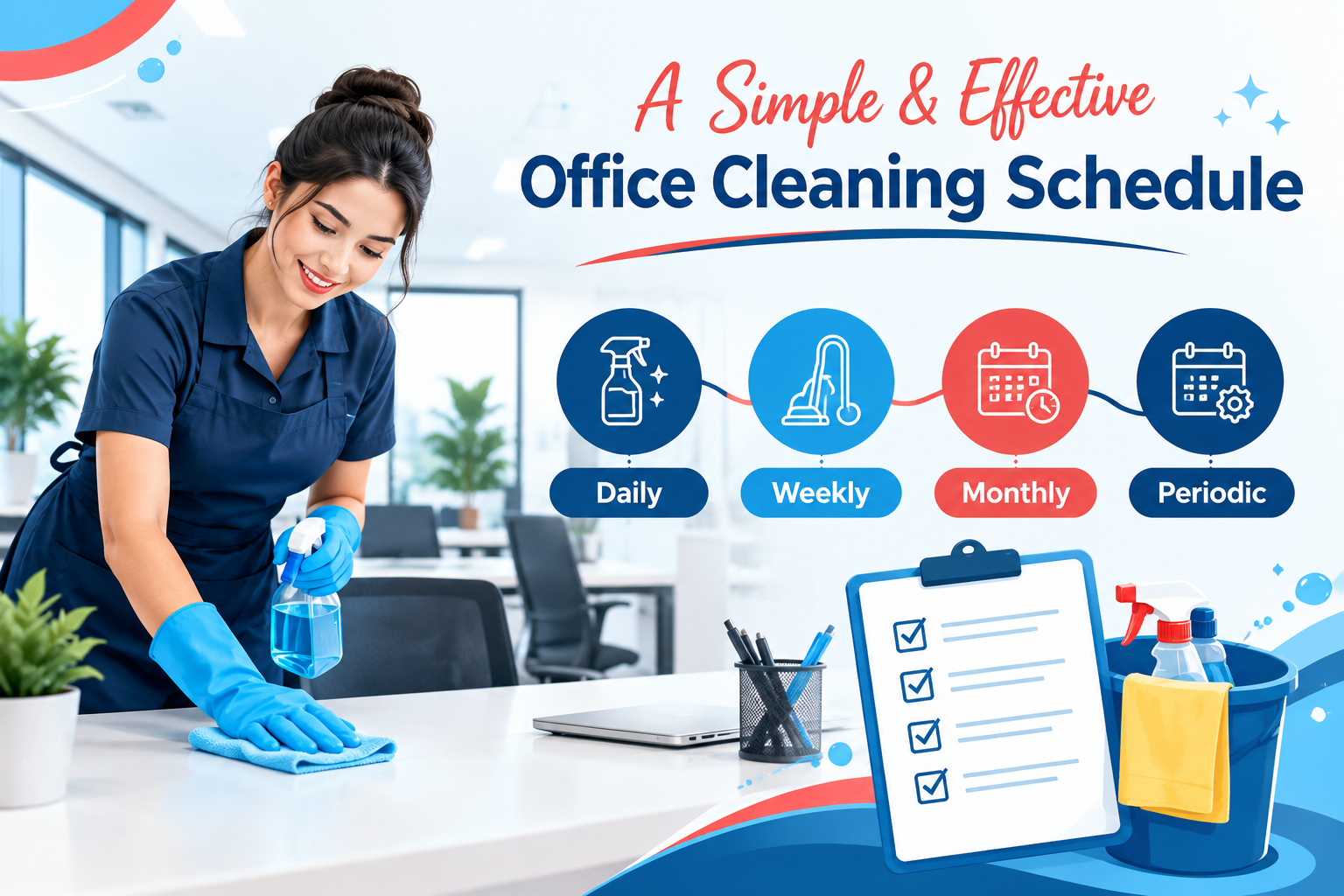
Here is a practical framework businesses can adapt.
Every Day
Focus on high-use areas.
✔ Empty trash
✔ Clean visible spills
✔ Maintain restrooms
✔ Wipe high-touch surfaces
✔ Clean kitchen and break-room surfaces
✔ Spot-clean floors
✔ Maintain entrances
Every Week
Focus on routine detailed maintenance.
✔ Vacuum floors
✔ Mop hard surfaces
✔ Dust work areas
✔ Clean conference rooms
✔ Clean interior glass
✔ Detail restrooms
✔ Clean shared spaces
Every Month
Focus on less frequently cleaned areas.
✔ Detailed dusting
✔ Clean doors and frames
✔ Review vents and fixtures
✔ Clean under and around furniture
✔ Review problem areas
✔ Inspect areas needing additional service
Periodically
Focus on larger or specialized needs.
✔ Deep cleaning
✔ Carpet or floor projects
✔ Seasonal cleaning
✔ Post-construction cleaning
✔ Special event cleaning
✔ Additional glass or detail cleaning
This structure gives businesses a starting point without forcing every property into the same routine.
When Should You Adjust Your Office Cleaning Frequency?
Your schedule may need to change when you notice specific warning signs.
Increase service frequency when:
- Trash regularly overflows
- Restrooms become difficult to maintain
- Floors look dirty before the next scheduled cleaning
- Kitchen areas develop noticeable buildup
- Employees frequently complain about cleanliness
- Customer-facing areas look neglected
- High-touch surfaces need constant attention
You may also need additional cleaning during busy seasons, special events, office moves, renovations, or periods of increased occupancy.
A cleaning schedule should be reviewed based on actual results.
If the office does not look or feel clean between scheduled visits, the schedule is telling you something.
When Professional Commercial Cleaning Makes Sense
Professional service becomes especially valuable when the business has multiple rooms, significant foot traffic, customer-facing areas, or cleaning requirements that employees cannot realistically manage.
A professional cleaning company can take recurring maintenance off the staff’s workload and provide a consistent system for keeping the space clean.
Lajas Cleaning Services offers Commercial Cleaning for offices, small businesses, retail spaces, restaurants, and professional buildings, allowing businesses to create service routines based on their specific needs.
The goal is not simply to have someone clean the office.
It is to have a cleaning system that works reliably as part of the business.
Ready to Build a Better Office Cleaning Schedule?
A cleaning schedule should make commercial maintenance easier, not more complicated.
Start by identifying your high-traffic areas, separating daily from less frequent tasks, assigning responsibilities, and choosing cleaning times that fit your operating hours.
For businesses that need ongoing professional support, Commercial Cleaning can help turn cleaning from a reactive task into a predictable part of property maintenance.
Whether you manage a small office, retail space, restaurant, or professional building, the right schedule can help keep the workplace cleaner without putting the entire responsibility on employees.
Final Thoughts
Learning how to create an office cleaning schedule is really about turning cleaning into a repeatable system.
Start with the areas that experience the most traffic. Separate daily tasks from weekly, monthly, and periodic work. Make responsibilities clear. Schedule professional service when the workload is too large or specialized for employees.
Most importantly, review the schedule over time.
A workplace is not static. Employees change, businesses grow, customer traffic shifts, and buildings are used differently from one year to the next.
Your cleaning plan should evolve with it.
A good schedule does not mean every surface gets cleaned every day.
It means the right areas are cleaned at the right frequency by the right people.
Frequently Asked Questions
How do I create an office cleaning schedule?
Start by listing cleaning tasks, dividing them into daily, weekly, monthly, and periodic categories, then assign responsibilities based on the needs and traffic levels of each area.
What should be included in an office cleaning schedule?
A basic schedule should cover trash, restrooms, floors, desks and surfaces, kitchens or break rooms, high-touch areas, entrances, conference rooms, and periodic deep-cleaning tasks.
How often should an office be cleaned?
The appropriate office cleaning frequency depends on employee numbers, foot traffic, business type, and the amount of daily activity. High-traffic offices may need more frequent service.
Should employees clean the office?
Employees can handle simple personal upkeep and immediate messes, but larger recurring cleaning tasks are often better assigned to a professional commercial cleaning provider.
How often should office floors be cleaned?
High-traffic floors may require daily attention or frequent spot cleaning, while detailed vacuuming and mopping can be scheduled weekly or more often depending on the property.
How do you make a workplace cleaning schedule easier to manage?
Separate tasks by frequency, identify who is responsible, and review the schedule regularly to make sure it still matches the business’s needs.
Should small businesses have a cleaning schedule?
Yes. A simple schedule can help small businesses prevent missed tasks and maintain a consistent appearance without needing an overly complicated system.
When should an office cleaning schedule be changed?
Review it when employee numbers, building size, traffic, operating hours, layout, or business activities change, or when the current schedule no longer keeps the workplace consistently clean.
What is the difference between daily cleaning and periodic cleaning?
Daily cleaning focuses on high-use areas and routine upkeep. Periodic cleaning addresses tasks that do not need daily attention, such as deeper cleaning, seasonal service, and special projects.
Can a professional cleaning company create a customized schedule?
Yes. A professional provider can help structure recurring service around the building type, operating schedule, traffic levels, and cleaning priorities.