

Three days after the crew packed up, the floor looks dusty again, even though nobody’s touched it. That’s the part nobody warns you about: knowing how to remove construction dust from floors after renovation isn’t really about one big cleaning session. It’s about understanding why fine dust keeps resettling, and doing things in an order that actually breaks the cycle instead of spreading it around.
Here’s what genuinely works, why sweeping and regular vacuuming often make things worse before they get better, and when it makes sense to bring in a professional post construction cleanup instead.
Key Takeaways
- Construction dust is fine enough to stay airborne and resettle for days, which is why one cleaning pass rarely finishes the job.
- Sweeping and standard vacuums often stir dust back into the air instead of removing it. A HEPA filter matters more than most people expect.
- The right order matters: vacuum first, wipe surfaces top to bottom, mop last with frequently changed water.
- A full post construction cleaning resets the whole space in one visit when the mess is bigger than a weekend project.
Why Does Construction Dust Keep Coming Back?
Construction dust, especially drywall dust and fine debris from sanding, cutting, or demolition, is made up of particles small enough to stay suspended in the air long after work stops. Every time a surface is disturbed, some of that settled dust gets kicked back up, which is why floors can look freshly dusty days after the last worker left.
HVAC systems make this worse by pulling dust into vents and recirculating it through the house. Foot traffic, opening doors, and even walking across a “clean” floor can resuspend particles that settled overnight. That’s the real reason a single sweep and mop rarely solves the problem: the dust hasn’t been removed, it’s been relocated.
Construction Dust Cleanup: What Actually Works
The order you clean matters as much as the tools you use. Vacuum first with a HEPA filter, wipe surfaces from top to bottom, and mop floors last with water you change often, since mopping first just pushes fine dust into a paste that’s harder to remove.
Here’s why each step matters and what to skip.
The Top Down, Wet Last Method
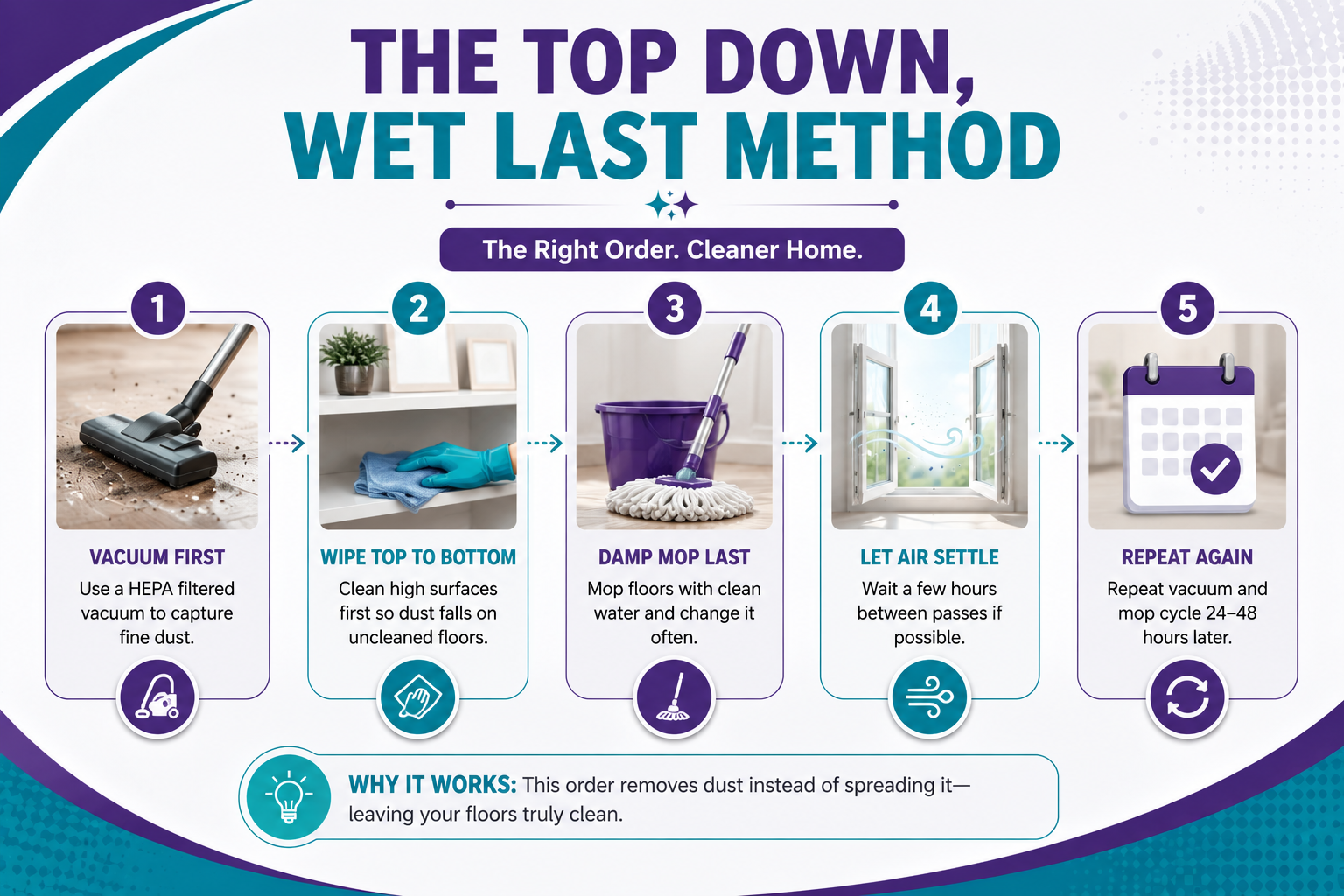
- Vacuum with a HEPA filtered vacuum first. Standard vacuums often blow fine dust back out through the exhaust, making the air worse.
- Wipe hard surfaces top to bottom. Light fixtures, shelves, and counters before floors, so dust falls onto a floor you haven’t cleaned yet, not one you just finished.
- Damp mop floors last, changing the water frequently. A few passes with clean water outperform one long pass with dirty water.
- Let the air settle for a few hours between passes when possible, especially if HVAC has been recirculating dust.
- Repeat the vacuum and mop cycle a second time, 24 to 48 hours later, to catch dust that resettles after the first pass.
Which Cleaning Method Actually Removes Dust?
| Method | Effectiveness on Fine Dust | Risk |
| Dry sweeping | Low | Stirs dust back into the air |
| Standard vacuum | Moderate | Can exhaust fine particles back out |
| HEPA filtered vacuum | High | Captures fine particles instead of releasing them |
| Damp mopping (done last) | High | Effective once loose dust is already removed |
Sweeping first and vacuuming last is one of the most common mistakes. It does the steps in reverse order, so the dust a vacuum should have caught has already been pushed into the air by the broom.
What Most Homeowners Get Wrong After a Renovation
Myth: One thorough cleaning session finishes the job. Reality: Fine construction dust resettles for days after a project wraps, especially from drywall work. A second pass 24 to 48 hours later catches what the first one missed.
Myth: Running fans or opening windows clears the dust faster. Reality: Airflow can resuspend settled dust and spread it to rooms that weren’t part of the renovation, undoing progress instead of speeding it up.
Do this, not that: Don’t sweep dry dust before vacuuming. HEPA vacuum first, then wipe and mop, so each step removes dust instead of relocating it to the next surface.
Fine dust from renovation work isn’t just a cosmetic problem, either. Larger renovation projects, especially ones involving drywall, concrete, or tile, can generate crystalline silica dust, a substance that’s closely regulated on job sites because of the health risks tied to repeated exposure over time. That’s part of why thorough removal, not just a quick wipe down, matters more than it might seem, particularly for anyone spending extended time in the space during and right after a renovation.
A Common Scenario: The Weekend Cleanup That Didn’t Stick
Picture a homeowner who finished a kitchen remodel and spent a Saturday sweeping, vacuuming with a regular household vacuum, and mopping the floors. Everything looked spotless by Sunday night. By Wednesday, a fine gray film was back on the counters and floor, and dust was visibly settling on dark surfaces near the vents. Nothing had gone wrong: the cleaning simply hadn’t accounted for dust still circulating through the HVAC system and resettling over several days. A second HEPA vacuum and mop pass a few days later, done in the right order, finally broke the cycle.
Where Professional Post Construction Cleaning Fits In
For a single room or a small touch up project, the steps above are usually enough. For a full remodel, an addition, or new construction, the volume of dust, and the number of surfaces it settles on, often makes DIY cleanup a mult weekend project instead of a Saturday task.
That’s where our post construction cleaning service in Joliet comes in. We address every surface, corner, and hard to reach area, from sweeping and vacuuming to sanitizing and polishing, so a renovated space is ready for occupancy in one visit instead of several rounds of resettling dust. It’s a service several of our clients have turned to specifically because a DIY cleanup after a bigger project kept coming back short.
If the renovation is done but the rest of the home also needs attention, pairing post construction cleanup with a deep cleaning visit is a common way to reset the whole space at once.
The Bottom Line
So, how do you remove construction dust from floors after renovation for good? Vacuum with a HEPA filter first, work top to bottom, mop last, and plan on a second pass a day or two later. Dust resettling isn’t a sign you did something wrong, it’s just how fine particles behave.
For anything beyond a single room, professional post construction cleaning saves the repeated weekends of chasing dust that keeps coming back, and gets the space genuinely ready to use.

Either way, the goal is the same: dust that’s actually gone, not just moved to a different surface.
FAQ
How do I remove construction dust from floors after renovation?
Vacuum with a HEPA filtered vacuum first, wipe surfaces from top to bottom, and mop floors last using clean water that’s changed frequently. A second cleaning pass 24 to 48 hours later catches dust that resettles after the first round.
Why does dust keep coming back after I’ve already cleaned?
Fine construction dust stays airborne longer than regular household dust and gets recirculated through HVAC systems and foot traffic. It often takes more than one cleaning pass over a few days to fully settle and get removed.
Can I use a regular vacuum for construction dust?
A regular vacuum can help, but many models exhaust fine particles back into the air instead of trapping them. A HEPA filtered vacuum is more effective at actually capturing dust rather than redistributing it.
Should I sweep or vacuum construction dust first?
Vacuum first. Sweeping stirs fine dust into the air before it can be captured, which usually means more of it resettles on surfaces you’ve already cleaned.
Is it worth hiring a post construction cleaning service instead of doing it myself?
For a small area, DIY cleanup is often enough. For a full remodel or new construction, a professional post construction cleaning service saves the repeated cleaning passes that a large amount of settled dust usually requires.
Does Lajas Cleaning Services offer post construction cleaning in Joliet?
Yes. Lajas Cleaning Services provides post construction cleaning designed to remove dust, debris, and construction residue in Joliet and surrounding areas, addressing every surface and hard to reach area.
How long does construction dust stay in a house after renovation?
It varies by project size, but fine dust can continue resettling for several days to a couple of weeks after work ends, especially if HVAC systems have been circulating it through the home.
Is construction dust bad to breathe in during cleanup?
Yes, dust from materials like drywall, concrete, and tile can be irritating to breathe, and larger renovation projects may involve regulated substances like silica dust that require careful handling.
Do I need to change my HVAC filter after a renovation?
It’s a reasonable step to check, since HVAC systems can circulate settled dust throughout a home during and after a renovation, though your HVAC provider is the right resource for filter specific guidance.